
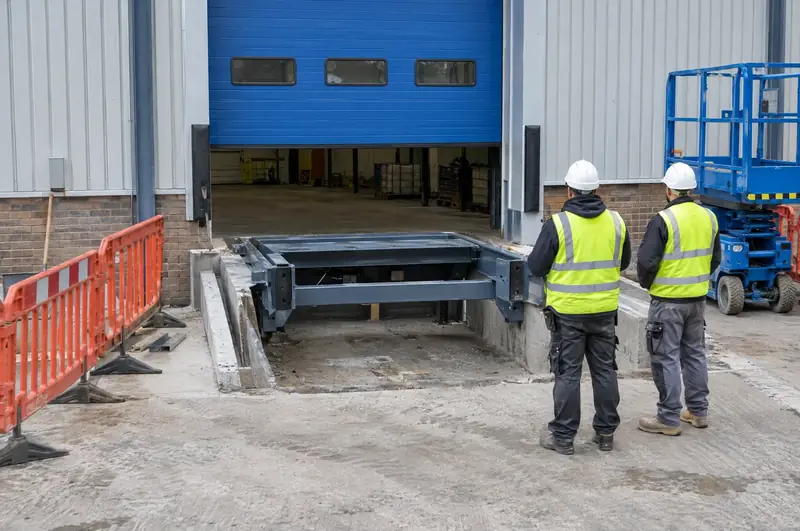
A loading bay conversion is a project that changes how a loading opening works, most often turning a ground-level door into a dock by lowering the approach, forming a leveller pit or adding a dock lift. It also covers upgrading older bays with new levellers, insulated doors, shelters and safety equipment while reusing the structure that is still sound.
Why do sites in Tyne and Wear choose this?
Older factories in Tyne and Wear built with ground-level roller shutters are frequent conversion candidates once the business starts receiving articulated trailers rather than vans. Landlords in Tyne and Wear upgrading vacant units to attract logistics tenants can add docks or modernise tired bays as part of wider refurbishment works.
Ground conditions, drainage and buried services vary from site to site in Tyne and Wear, which is why every conversion starts with a levels survey before any design.
Keeping the dock running is usually the first concern, so we plan around it. After a free survey of your Tyne and Wear site and a written quote at a fixed price, we agree when each bay can be released and whether any work should happen out of hours. Specialist installation engineers working under our management then fit the equipment, and we test it and hand over the documentation before the bay goes back into use.
When is upgrading an old bay better than rebuilding it?
Upgrading is usually better when the pit, dock face and opening are sound and the right size for today's trailers, because the expensive structural work can be reused. Rebuilding makes sense when the structure itself is the problem.
Signs an upgrade will work:
- the pit is dry, uncracked and suits a modern hydraulic leveller of the length you need;
- the opening suits a modern insulated door and shelter;
- dock height suits most of the trailers you receive.
Signs a rebuild is needed:
- the pit is cracked, holds water or is too short for the trailer height range;
- the dock face is broken up from years of impact;
- the opening is too small for current trailers and loads.
The survey records the condition of each element, and the quote explains which parts are reused and which are replaced.
How is downtime managed during a loading bay conversion?
Downtime during a conversion is managed by phasing the work bay by bay and agreeing a temporary loading arrangement before anything is broken out. A converted bay is out of use for the whole of its civils and installation period, so planning matters.
- Phasing: one bay or a pair of bays at a time, keeping enough doors open for your peak loads.
- Temporary loading: a neighbouring dock, a ground-level door or a mobile ramp used while the bay is closed.
- Curing time: new concrete needs time to gain strength before trailers and forklifts use it, and the programme allows for this.
- Security: openings are kept secure with temporary hoarding or the new door fitted early.
We ask you to provide site plans and any drawings of buried services, space for plant and spoil, a delivery area and a nominated contact. Our guide to upgrading loading bays without stopping the operation has more on phasing.
Towns we cover in Tyne and Wear
Looking for loading bay conversions in a specific part of Tyne and Wear? Start with the nearest town on this list.
- Newcastle upon Tyne
- Sunderland
- South Shields
- Gateshead
- Washington
- Tynemouth
- Wallsend
- Newburn
- North Shields
- Whitley Bay
- Houghton-le-Spring
- Felling
- Jarrow
- Gosforth
- Hebburn
- Whickham
- Blaydon-on-Tyne
Budget range for supply and fit. The written quote after a free survey is the fixed price. All guide prices.
Regulations and approvals in England
Lift tables and dock lifts in Tyne and Wear may fall under LOLER, with thorough examination at least every 12 months, or every 6 months where people are lifted. It depends on the equipment and how it is used, and your insurer or competent person will confirm. Dock levellers are usually treated as work equipment under PUWER. We check what applies at survey.
Questions
How long does installation take at a site in Tyne and Wear?
It depends on the equipment, the number of bays, the condition of the dock and whether any building or electrical work is needed. We agree a programme with you after the survey, setting out which bays are out of use and when. Larger jobs are usually phased so that part of the dock stays open, and out-of-hours working can be arranged.
How do you price loading bay conversions for a site in Tyne and Wear?
Guide budgets for supply and fit are £18,000 to £45,000 per bay, excluding VAT. The figure moves with size, insulation, the operator, electrics, access, any pit or groundworks and out-of-hours working. Where levellers are involved, the guide assumes an existing, sound pit. After the free survey you receive a fixed written quote, and that is the price for the agreed scope.
Can we keep working during a conversion?
Yes, in most cases. Conversions are phased bay by bay so the rest of the dock keeps running, and temporary loading is agreed before any bay is taken out of use. Openings are kept secure throughout, and noisy or disruptive work can be timed around your busiest periods.
Do I need a new door when converting a bay?
Not always. If the opening stays the same size and the door is in good condition, it can sometimes be kept. Where the opening changes or the door is old and uninsulated, a new door is usually included, and in England it should meet the Approved Document L limiting U-value for large doors.
Other services in Tyne and Wear
Full guide to loading bay conversions · All loading bay services in Tyne and Wear