
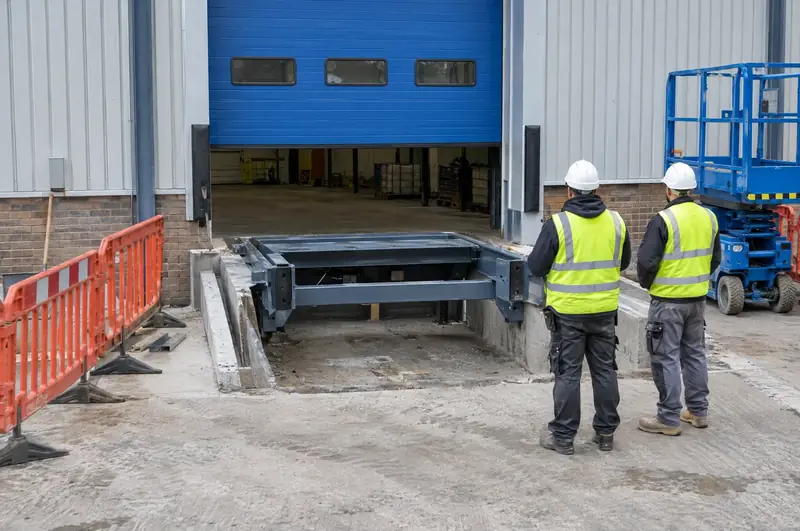
A loading bay conversion is a project that changes how a loading opening works, most often turning a ground-level door into a dock by lowering the approach, forming a leveller pit or adding a dock lift. It also covers upgrading older bays with new levellers, insulated doors, shelters and safety equipment while reusing the structure that is still sound.
What matters for loading bay conversions in Dorset?
Bays in Dorset still running mechanical levellers and uninsulated shutters are often upgraded in one project with new hydraulic levellers, insulated doors and shelters. Older factories in Dorset built with ground-level roller shutters are frequent conversion candidates once the business starts receiving articulated trailers rather than vans.
Planning and building control questions for a conversion in Dorset are checked during the survey, so the programme allows for any approvals that are needed.
Keeping the dock running is usually the first concern, so we plan around it. After a free survey of your Dorset site and a written quote at a fixed price, we agree when each bay can be released and whether any work should happen out of hours. Specialist installation engineers working under our management then fit the equipment, and we test it and hand over the documentation before the bay goes back into use.
What are the ways to convert a ground-level door into a dock?
There are three main ways to convert a ground-level door into a dock: lower the yard to form a recessed approach, install a dock lift at the door, or add a dock alongside the building. The right one depends on yard space, levels and how many trailers you handle.
- Recessed approach: the yard is excavated on a gradient so the trailer bed meets the building floor, with a leveller and drainage at the dock face. Best for high trailer volumes where there is yard depth for the ramp.
- Dock lift: a scissor lift table at the door raises goods to trailer height. Good for tight sites and mixed fleets.
- Edge-of-dock solutions: where the height difference is small, a modest recess with an edge-of-dock leveller can be enough.
Upgrades to existing docks follow the same survey: replacing mechanical levellers, swapping shutters for insulated doors, and adding shelters and restraints. Our guide to converting a ground-level door into a loading dock compares the methods.
How is downtime managed during a loading bay conversion?
Downtime during a conversion is managed by phasing the work bay by bay and agreeing a temporary loading arrangement before anything is broken out. A converted bay is out of use for the whole of its civils and installation period, so planning matters.
- Phasing: one bay or a pair of bays at a time, keeping enough doors open for your peak loads.
- Temporary loading: a neighbouring dock, a ground-level door or a mobile ramp used while the bay is closed.
- Curing time: new concrete needs time to gain strength before trailers and forklifts use it, and the programme allows for this.
- Security: openings are kept secure with temporary hoarding or the new door fitted early.
We ask you to provide site plans and any drawings of buried services, space for plant and spoil, a delivery area and a nominated contact. Our guide to upgrading loading bays without stopping the operation has more on phasing.
Towns we cover in Dorset
Find your town in the list below for details of loading bay conversions across Dorset, or contact us if your location is not shown.
Budget range for supply and fit. The written quote after a free survey is the fixed price. All guide prices.
Planning, building control and safety law in England
In England, Approved Document L (2021) sets a limiting U-value of 1.3 W/m²K for vehicle access and similar large doors in new and replacement work. That shapes door specification for sites in Dorset, so we confirm the requirement for your project and check what applies at survey before recommending a door.
Questions
Is the site survey in Dorset free?
Yes. For new installations, replacements, upgrades, conversions and complete bays, the site survey and written quote are free and come with no obligation. The survey lets us measure the openings, check the dock and structure, and understand how the bay is used, so the quote reflects your site. Repair and servicing visits are different: they are chargeable, with the price agreed before anyone attends.
What warranty comes with new loading bay equipment?
New equipment comes with the manufacturer's warranty, which varies by product. Our workmanship terms are set out in writing in the quote for your Dorset site, so you can see what is covered before you commit. Check the warranty terms for any servicing conditions, and we can quote for planned maintenance once the installation is complete.
Who carries out the groundworks for a conversion?
Groundworks are carried out by specialist contractors working under our management, so you have one point of contact for the whole conversion. The groundworks are designed around the equipment chosen, which avoids the mismatches that can happen when civils and dock equipment are bought separately.
How long does a loading bay conversion take?
The length of a conversion depends mainly on the civils, concrete curing and any approvals needed before work starts. Upgrade-only projects are much quicker than full conversions. We set out the programme for each bay in writing with the quote, so you can plan temporary loading.
Other services in Dorset
Full guide to loading bay conversions · All loading bay services in Dorset