
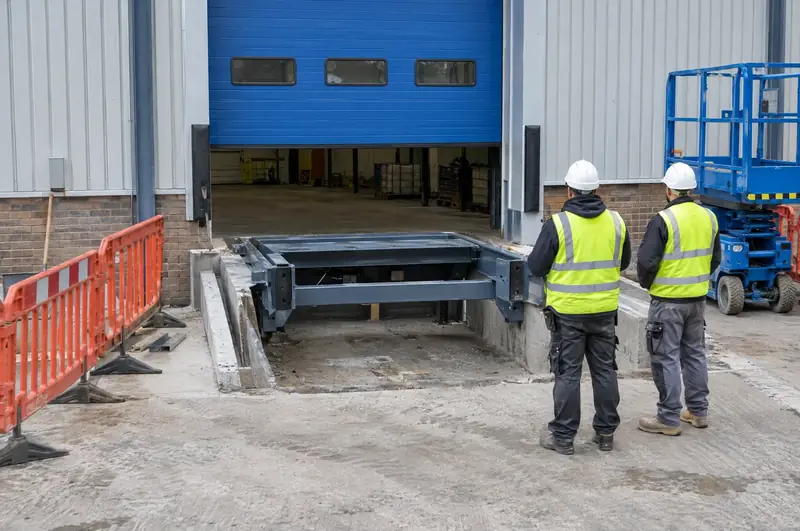
A loading bay conversion is a project that changes how a loading opening works, most often turning a ground-level door into a dock by lowering the approach, forming a leveller pit or adding a dock lift. It also covers upgrading older bays with new levellers, insulated doors, shelters and safety equipment while reusing the structure that is still sound.
Why do sites in Dundee and Angus choose this?
Planning and building control questions for a conversion in Dundee and Angus are checked during the survey, so the programme allows for any approvals that are needed. Bays in Dundee and Angus still running mechanical levellers and uninsulated shutters are often upgraded in one project with new hydraulic levellers, insulated doors and shelters.
Landlords in Dundee and Angus upgrading vacant units to attract logistics tenants can add docks or modernise tired bays as part of wider refurbishment works.
For loading bay conversions in Dundee and Angus, we begin with a free site survey and a fixed written quote, so you know the scope and cost before committing. We take responsibility for managing the job, and specialist installation engineers carry it out under our supervision. Bays are taken out of use in a planned sequence so the rest of the dock keeps working, and evening or weekend work can be arranged. Each item is tested at handover and the documentation is left with you.
Does a loading bay conversion need building regulations approval or planning permission?
A loading bay conversion often needs building approval, and sometimes planning permission, so we check both at survey before the design is fixed. Forming a new opening or a dock pit is a structural alteration.
- England and Wales: Building Regulations approval may be needed.
- Scotland: a building warrant may be needed.
- Northern Ireland: building control approval may be needed.
External changes such as a new dock approach, a loading house or a canopy can need planning permission. We never assume permission is not needed.
Replacement doors also fall under energy rules. In England, Approved Document L (2021) Volume 2 sets a limiting U-value of 1.3 W/m²K for vehicle access and similar large doors in new and replacement work. Wales, Scotland and Northern Ireland have their own energy rules, and we confirm the figure that applies to your nation and project.
Once complete, the new equipment is work equipment under PUWER, or PUWER (Northern Ireland) 1999, and must be maintained and inspected.
What does a loading bay conversion involve, step by step?
A loading bay conversion runs from a levels survey through design and approvals to civils, equipment and commissioning. A typical recessed-dock conversion follows this order:
- Levels survey: floor, yard and drainage levels, plus buried services.
- Design: approach gradient, pit and dock face details, drainage and equipment layout.
- Approvals: building control and any planning application.
- Civils: breaking out, excavation, retaining walls, drainage, pit and new concrete.
- Opening works: adjusting the opening and making good the cladding or masonry.
- Equipment: leveller, door, shelter or seal, bumpers and wheel guides.
- Electrics and controls: supplies, panels, lights and any interlocks.
- Commissioning: testing with a trailer and handover.
Upgrade-only projects skip most of the civils, which is why they cost less and finish sooner. All work is carried out by specialist groundworks, installation and electrical teams working under our management.
Towns we cover in Dundee and Angus
Choose a town below to see how we handle loading bay conversions in that part of Dundee and Angus.
Budget range for supply and fit. The written quote after a free survey is the fixed price. All guide prices.
Regulations and approvals in Scotland
Doors and dock equipment installed in Scotland may carry the UKCA or the CE mark, and we pass on the documentation for everything fitted in Dundee and Angus. Because building warrant and planning questions can affect the programme, we check what applies at survey and raise any approvals early rather than assuming none are needed.
Questions
How long does installation take at a site in Dundee and Angus?
It depends on the equipment, the number of bays, the condition of the dock and whether any building or electrical work is needed. We agree a programme with you after the survey, setting out which bays are out of use and when. Larger jobs are usually phased so that part of the dock stays open, and out-of-hours working can be arranged.
Is the site survey in Dundee and Angus free?
Yes. For new installations, replacements, upgrades, conversions and complete bays, the site survey and written quote are free and come with no obligation. The survey lets us measure the openings, check the dock and structure, and understand how the bay is used, so the quote reflects your site. Repair and servicing visits are different: they are chargeable, with the price agreed before anyone attends.
How long does a loading bay conversion take?
The length of a conversion depends mainly on the civils, concrete curing and any approvals needed before work starts. Upgrade-only projects are much quicker than full conversions. We set out the programme for each bay in writing with the quote, so you can plan temporary loading.
Who carries out the groundworks for a conversion?
Groundworks are carried out by specialist contractors working under our management, so you have one point of contact for the whole conversion. The groundworks are designed around the equipment chosen, which avoids the mismatches that can happen when civils and dock equipment are bought separately.
Other services in Dundee and Angus
Full guide to loading bay conversions · All loading bay services in Dundee and Angus