
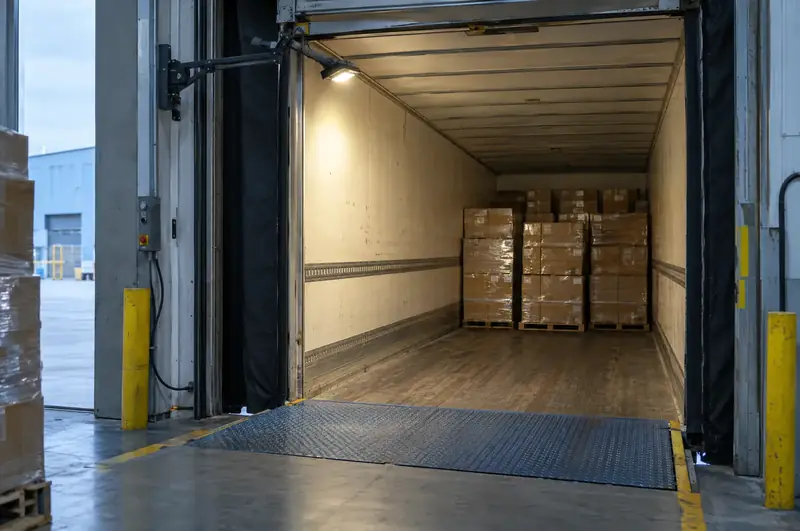
Dock lights and wheel guides are two simple loading bay aids. A dock light is a lamp, usually LED, on a swing arm beside the dock door that shines into the trailer so forklift drivers can see the load. Wheel guides are steel rails fixed to the yard that steer the rear wheels so the trailer arrives straight and centred on the leveller.
Where does this fit at a dock in Staffordshire?
Parcel and retail distribution operators in Staffordshire that work into the evening rely on good lighting inside trailers once daylight at the dock fades. Resurfacing works on a yard in Staffordshire are an ideal moment to fit cast-in wheel guides, before the concrete is finished and bays come back into use.
Warehouses in Staffordshire loading deep trailers by forklift often find the back of the load hard to see without a dock light reaching into the trailer.
Keeping the dock running is usually the first concern, so we plan around it. After a free survey of your Staffordshire site and a written quote at a fixed price, we agree when each bay can be released and whether any work should happen out of hours. Specialist installation engineers working under our management then fit the equipment, and we test it and hand over the documentation before the bay goes back into use.
Should wheel guides be bolted down or cast in?
Wheel guides are bolted down on an existing sound concrete yard and cast in where new concrete is being laid. Both give a strong fixing; the choice depends on whether the yard is being resurfaced.
- Bolt-down guides: steel tube or channel fixed with resin anchors. Quick to fit to existing bays and easy to replace if damaged.
- Cast-in guides: set into fresh concrete with embedded anchors, suited to new-build docks and conversions.
- Flared entry: an angled lead-in at the yard end catches the wheel early and steers it into line.
- Finish: typically galvanised, or painted yellow and black so drivers can see them in mirrors.
Guides are set out to suit the track width of the trailers you receive, centred on the leveller, and long enough to straighten the trailer before it reaches the bumpers. Tarmac is usually too soft to hold anchors, so a concrete strip or base is laid first. Our guide to choosing dock bumpers and wheel guides covers layout in more depth.
How do wheel guides protect shelters, seals and levellers?
Wheel guides protect dock equipment by keeping every trailer centred on the bay, so contact forces land where the equipment is designed to take them. A trailer that parks off-centre loads one side of the dock much harder than the other.
- Shelters: off-centre trailers catch the side curtains and frame, causing tears and bent arms.
- Seals: one pad is crushed while the other barely touches, leaving gaps for draughts and rain.
- Levellers: the lip can land near the edge of the trailer bed, with less support for forklifts.
- Bumpers: one bumper takes every impact and wears out early.
Dock lights help in a different way: forklift drivers who can see clearly inside the trailer are less likely to strike the trailer walls or the door frame on the way out. Combining guides and lights with correctly positioned dock bumpers gives a well-protected bay.
Towns we cover in Staffordshire
Each of the following towns in Staffordshire has its own page on dock lights and wheel guides, covering how we work and what to send us.
- Stoke-on-Trent
- Newcastle-under-Lyme
- Burton upon Trent
- Cannock
- Tamworth
- Stafford
- Lichfield
- Kidsgrove
- Burntwood
- Rugeley
- Leek
- Great Wyrley
- Biddulph
Budget range for supply and fit. The written quote after a free survey is the fixed price. All guide prices.
What do the rules in England mean for the work?
Workplace safety in England is regulated by HSE. For a loading bay in Staffordshire, that means doors meeting regulation 18 of the Workplace (Health, Safety and Welfare) Regulations 1992, equipment maintained under PUWER and suitable safeguards against vehicles driving away too early. We check what applies at survey and design the bay accordingly.
Questions
Can you work outside our normal operating hours in Staffordshire?
Yes, by arrangement. Evening, night and weekend working can be planned so the installation causes as little disruption as possible to your loading schedule. Out-of-hours work can affect the price, so mention it at the survey and we will include it in the written quote. The agreed times are confirmed in the programme before the job starts.
Can you work alongside our main contractor on a new build in Staffordshire?
Yes. For new warehouses and fit-outs, we can supply and install the dock package as part of a wider project, working to the main contractor's programme, site rules and permits. We will need drawings, dock levels and the programme, and we coordinate pit details, power supplies and door openings with the relevant trades before installation begins.
Are LED dock lights better than older lamps?
LED dock lights are generally the better choice. They run much cooler, so there is less risk of heat damage to goods or packaging close to the head, they cope well with vibration, and they reach full brightness straight away. They also use less electricity for the same light, although savings depend on how long the lights are on.
Can dock lights be fitted without stopping loading?
Usually yes. Dock lights are fitted from inside the building beside the door, and the bay can often keep working except for a short period while the supply is isolated and connected. We agree timings with you so the work fits around trailer arrivals.
Other services in Staffordshire
Full guide to dock lights and wheel guides · All loading bay services in Staffordshire