
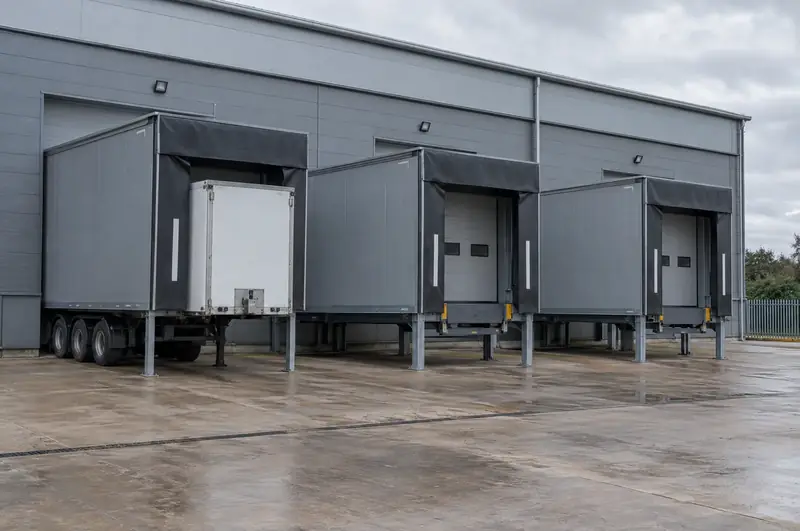
A loading house is an insulated steel structure built against the outside wall of a building, containing a dock leveller and usually a shelter or seal at its front. The building door closes at the wall line, while trailers dock against the house. Loading houses suit buildings whose floor is at dock height but which have no room inside for a leveller pit.
How does this suit sites in Gwent?
Where a yard in Gwent is narrow, an angled loading house lets trailers approach on a diagonal and can sometimes fit more bays along one wall. Any loading house proposed in Gwent needs its planning and building control position checked, which we look at during the site survey before quoting.
Manufacturing businesses around Gwent adding a dock to an existing building often find a loading house less disruptive than breaking out the slab inside.
It starts with a free site survey in Gwent, where we measure the openings, check the dock and talk through how the bay is used. You then receive a fixed written quote. Once you accept, we manage the job: specialist installation engineers carry out the work under our management, planned around your deliveries, and out-of-hours working can be arranged. At handover we test everything with you and leave the documentation.
When is a loading house better than an internal dock?
A loading house is usually the better option when the building floor is already at dock height but there is no practical way to form a leveller pit inside. It moves the whole dock outside the wall, leaving the internal floor clear.
- No room inside: racking, production lines or mezzanines sit right up to the wall.
- Difficult slab: the floor slab carries services or is unsuited to breaking out for a pit.
- Thermal control: the building door closes at the wall line, so the leveller sits outside the heated or chilled space when no trailer is docked.
- Security: the building can be closed at the wall line while the house itself stays open to the yard.
- Narrow yards: an angled house lets trailers approach on a diagonal and can fit more bays along one wall.
Where the building floor is at yard level, a loading house alone will not solve the height difference, and a recessed approach or lift table is usually needed instead.
How much does a loading house cost?
A loading house typically costs £14,500 to £32,000 per house, supplied and installed, excluding VAT. That covers the insulated structure with its leveller and shelter or seal; the figure for your site depends on size, layout and what has to happen to the building and yard.
What moves the price:
- Size and layout: straight houses are simpler than angled ones, and larger houses use more steel and panel.
- Leveller type: telescopic-lip levellers cost more than swing-lip.
- Front sealing: inflatable shelters cost more than retractable shelters or foam seals.
- Foundations: ground conditions and buried services decide the size of pads or footings.
- Building works: forming or enlarging the wall opening, and a new insulated door if needed.
- Electrics and access: supply to the leveller and lights, crane access and any out-of-hours working.
These are guide budgets. After a free site survey we send a written quote that is the fixed price. VAT is added at the standard rate.
Towns we cover in Gwent
We take enquiries about loading houses from across Gwent. These are the towns with their own pages:
Budget range for supply and fit. The written quote after a free survey is the fixed price. All guide prices.
Which rules apply in Wales?
Scissor lift tables and dock lifts in Wales can fall under LOLER, with thorough examination at least every 12 months, or every 6 months where people are lifted, depending on the equipment and its use. For sites in Gwent, your insurer or competent person will confirm the regime, and we check what applies at survey.
Questions
Do you remove and dispose of the old equipment?
Yes, where it is part of the scope. When we replace doors, levellers, shelters or seals at a site in Gwent, removal and disposal of the old equipment can be included and is itemised in the quote, so it is clear what is covered. If anything should be kept, such as a frame or motor that is still serviceable, we agree that at survey.
Is the site survey in Gwent free?
Yes. For new installations, replacements, upgrades, conversions and complete bays, the site survey and written quote are free and come with no obligation. The survey lets us measure the openings, check the dock and structure, and understand how the bay is used, so the quote reflects your site. Repair and servicing visits are different: they are chargeable, with the price agreed before anyone attends.
Can a loading house be used for a cold store?
Yes. Loading houses suit chilled and frozen operations because the building door closes at the wall line, keeping the cold space sealed when no trailer is docked. The panels, door and shelter or seal are specified to suit the temperatures involved, which we confirm at survey.
Can a loading house be moved later?
Loading houses are bolted steel structures rather than masonry, so in principle they can be dismantled and moved if your needs change. In practice, relocation needs new foundations and an opening at the new position, so it is usually considered only where a house is fairly new and the new position suits it.
Other services in Gwent
Full guide to loading houses · All loading bay services in Gwent